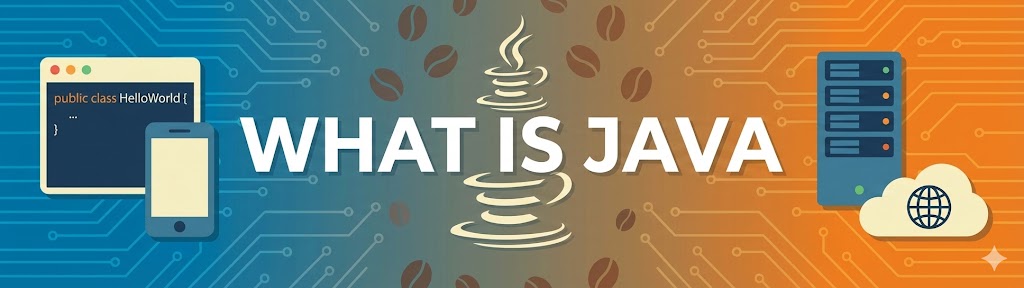
If you ever used an Android app, accessed an online banking interface, or worked with an enterprise-level application, chances are that Java was at work.
Java has been around since the mid-1990s. Still, it remains one of the most sought after and most widely used programming language platforms around the globe. It is behind everything, right from large-scale server-side implementations to big data platforms, trading engines, as well as Android apps.
☰Table of Contents
In this guide we will explore the concept of Java, its functionality, usage, its benefits, and what makes it a valuable programming language to learn today.
What is Java?
Java is an object-oriented, high-level, platform-independent programming language developed by Sun Microsystems that was first released in 1995. Nowadays, it is maintained by Oracle Corporation.
The core idea behind Java is its famous philosophy:
“Write Once, Run Anywhere” (WORA)
You write Java code once, compile it to an intermediate form called bytecode. Now, this bytecode runs on any system that has a Java Virtual Machine (JVM) installation, whether it be a Windows system, a macOS system, or an operating system like Linux.
Given its portability, performance, and reliability, it is no wonder why Java is on over seven billion devices worldwide.
Brief History and Evolution of Java
A quick timeline helps you understand why Java became so big:
Early 1990s – James Gosling and his team at Sun Microsystems started working on a project called Oak, which will eventually be renamed Java.
1995 – Release of Java 1.0, which is biased towards Internet-enabled applications.
2000s – Java emerges as the core technology of business apps, web servers, and app servers.
2010 – Oracle buys Sun Microsystems and further develops the Java language
Today – Java is currently among the leading programming languages in the world and widely adopted in business applications, Android, Big Data, and Cloud-Native.
Although new programming languages have appeared in the meantime, Java remains up-to-date and modern with added constructs such as Java Generics, Lambda Functions and Streams API in Java 8, and Records in Java
How Java Works (JDK, JRE, JVM, and Bytecode)
To really understand what Java is, you need to know how it runs.
The Java Workflow
You write source code in a file like MyProgram.java.
The Java compiler (javac) converts this code into bytecode stored in .class files.
The Java Virtual Machine (JVM) runs this bytecode on any supported operating system.
Since the JVM abstract the implementation details about the hardware and OS, it is possible to run the same bytecode on diverse platforms with no modification. This makes Java platform independent.
JDK vs JRE vs JVM
JVM (Java Virtual Machine): The engine that executes Java byte codes. It handles memory management, garbage collection, as well as the generation of machine codes from the byte codes.
JRE (Java Runtime Environment): Contains the JVM plus the essential libraries for running Java. A good choice if you merely want to run a program. JDK (Java Development Kit)
JDK (Java Development Kit): It includes the JRE environment, the Java compiler, and development tools. To create and compile Java code, you have to have the JDK.
Core Features of Java
There are many things that make Java appealing. Lets talk about them:
1. Platform Independent
Java is platform-independent because of JVM and bytecode. JVM translates the bytecode of Java into machine language. You don’t need to compile and convert the Java program on every OS.
2. Object-Oriented
Java is an object-oriented language, which means that the language revolves around classes and objects. Topics such as encapsulation, inheritance, abstraction, and polymorphism ensure that writing programs remains clean and reusable.
3. Simple and Familiar Syntax
The syntax of the Java programming language is almost the same as C++ and C, except for complex features such as memory management and multiple inheritance, which are eliminated.
4. Secure
Java has been designed with security considerations. The JVM sandbox environment, the bytecode verification process, and the robust set of standard libraries ensure that Java programs run securely for networks and the enterprise.
5. Robust and Reliable
Exception handling mechanisms, robust type verification systems, and garbage collection make Java more resilient to programming faults.
6. High Performance (for a High-Level Language)
Through the Just-In-Time Compilation capabilities provided by modern JVMs, Java has been able to function with good performance, which can serve larger-scale applications as well.
7. Multithreaded
Java provides inherent facilities for multithreading, which allows programmers to create interactive and concurrent systems.
8. Huge Standard Library and Ecosystem
The Java Standard Library, combined with popular libraries such as Spring, Spring Boot, Hibernate, etc., makes it possible to develop applications of almost every kind efficiently.
Where Is Java Used? Real-World Applications
From enterprise applications to IoTs, Java is being implemented everywhere. Now let us discuss about its applications.
1. Enterprise and Backend Applications
Java is a go-to language for the corporate application sphere, including banking systems, ERPs, CRMs, trading systems, billing systems, and other B2B applications. The benefits of Java lie in its high flexibility, stability, and security.
2. Android App Development
Java was the widely used language for building Android apps, and till date, the majority of the Android app is written in the Java language, although Kotlin is getting popular, and other languages are also being used to build Android apps.
3. Web Applications and Microservices
Since the ecosystem of Spring and Spring Boot, the usage of Java is prominent in building enterprise-level web applications and microservices. Java is used to create RESTful APIs, backend applications, as well as large-scale systems.
4. Cloud-Native Applications
Java is perfectly compatible with cloud systems such as AWS, Azure, or GCP. Most cloud-based applications developed with containers are based on the use of Java.
5. Big Data and Distributed Systems
Technologies such as Hadoop and certain big data processing engines are designed using Java or have strong interoperation with Java and are thus important to the Java community of data engineers.
6. Desktop and GUI Applications
Java can also be applied for developing desktop applications using JavaFX or older UI toolkits named Swing and AWT, even if the latter two are no longer as trendy as web or mobile Java.
7. Embedded and IoT
Due to its portability and robustness, Java is also used in embedded systems and IoT devices, especially when device resources are sufficient.
Java vs Other Programming Languages
When people search “What is Java?” they often also wonder how it compares to languages like Python, C++, or JavaScript.
Java vs Python: Python is often simpler for beginners and great for scripting, AI, and data science. Java is more verbose but better for large, structured, high-performance applications with strong typing.
Java vs C++: C++ offers more low-level control and is used for systems programming and game engines. Java trades some low-level control for safety, portability, automatic memory management, and a powerful runtime.
Java vs JavaScript: Despite the name, they are completely different. JavaScript is mainly for web front-end (and Node.js on the back end). Java is a general-purpose language for backend systems, Android, enterprise applications, and more.
Simple Java “Hello World” Program
Here’s a classic Hello World program in Java:
public class HelloWorld {
    public static void main(String[] args) {
        System.out.println("Hello, World!");
    }
}
public class HelloWorld – Defines a class named
HelloWorld.public static void main(String[] args) – Entry point of the Java application.
System.out.println(...) – Prints text to the console.
This structure may seem a bit verbose at first, but it reflects Java’s emphasis on consistent structure and object orientation
Advantages of Java
Platform independence – Write once, run anywhere.
High Performance for a Managed Language – JIT Compilation and JVM Optimization
Robust security mechanisms – Suitable for network and business applications.
Rich Ecosystem – Frameworks like Spring, Hibernate, Jakarta EE, and massive libraries.
Massive community - Documentation, tutorials, answers on Stack Overflow, online courses.
Mature tooling - IDEs like IntelliJ IDEA, Eclipse, and VS Code integrations.
Long-term stability - Suitable for systems that must operate for many years.
Limitations of Java
No language is perfect. Java has also its downsides:
More verbose syntax compared to languages like Python.
Slightly heavier memory usage due to the JVM.
Not as ideal for very low-level programming as C/C++.
GUI toolkits in Java are less popular for modern consumer apps compared to web/mobile frameworks.
Still, for large, long-lived, maintainable systems, Java’s trade-offs are often worth it.
Is Java Good for Beginners?
Yes - Java is an excellent language for beginners, and this is a common angle in beginner-friendly guides.
Here’s why:
Clear, consistent syntax
Strongly typed – helps you understand data types and errors early
Good foundation in object-oriented programming
Widely used in universities and bootcamps
Useful across many domains: web, Android, enterprise, cloud
If you learn Java well, moving to languages like C#, Kotlin, or even Python becomes much easier.
Career Opportunities With Java
Because Java is so widely adopted in enterprises, Java developers are always in demand. Common roles include:
Java Developer / Software Engineer
Backend Developer (Java + Spring Boot)
Android Developer (Java/Kotlin)
Full Stack Developer (Java + frontend)
Big Data / Hadoop Developer
Cloud & Microservices Engineer
Many large companies and startups rely on Java for core systems, making it a solid long-term career option.
How to Start Learning Java
If you’re motivated to start with Java, here’s a simple path:
Set up the environment
Install the JDK (Java Development Kit).
Use an IDE like IntelliJ IDEA, Eclipse, or VS Code.
Learn the basics
Syntax, variables, data types, operators
Conditional statements and loops
Methods and functions
Understand OOP concepts
Classes and objects
Inheritance, polymorphism, encapsulation, abstraction
Practice small projects
Console-based apps
Simple calculators, to-do lists, mini-games
Move to frameworks
Spring/Spring Boot for web and backend
Basic Android development if you’re interested in mobile
Build real projects
The more you build, the more confident and employable you become.
Conclusion: Why Java Still Matters
So, what is Java?
Java is a stable, powerful, and versatile programming language that has shaped modern software development for decades — and it’s not going away anytime soon.
It offers:
Platform independence
Strong performance and security
A massive ecosystem and community
Real-world applications across industries
Great career opportunities
Whether you are just starting your coding journey or planning your next career move, Java is a safe, future-proof, and highly practical language to invest your time in.