Being a digital marketing expert is currently one of the most profitable skills to have. Regardless of whether you're trying to launch your new career, grow your business, build your brand, or make money with freelance jobs, there aren't many professions that can offer you better prospects than digital marketing.
The need for skilled digital marketers only increases every day since more companies allocate their budgets to online advertising. What's even better, there's no need to study for a long time at college or university. Thanks to online courses, free tutorials, and projects, everybody can master the skills necessary for working in digital marketing.
☰Table of Contents |
Here we are going to discuss the ultimate guide on learning digital marketing – including steps to follow, crucial skills to learn, best free online resources, practical projects, careers in this field, and landing your first job.
What is Digital Marketing?
Digital marketing refers to the use of various Internet-based platforms to market products or services. This form of marketing is different from traditional marketing in that companies are able to market their products or services to target audiences, track performance in real time, and adjust tactics accordingly.
Some of the various types of digital marketing include:
Search Engine Optimization (SEO)
Content Marketing
Social Media Marketing (SMM)
Pay-Per-Click Advertising (PPC)
Email Marketing
Affiliate Marketing
Influencer Marketing
Marketing Analytics
Conversion Rate Optimization (CRO)
Why Learn Digital Marketing in 2026?
Here are some of the reasons why learning digital marketing is still among the best options in 2026:
High Demand In All Industries - Every sector from e-commerce, healthcare, finance, real estate, and others requires digital marketing specialists.
Various Career Options - You can become an SEO specialist, a content marketer, social media manager, PPC specialist, email marketing specialist, or marketing analyst.
Freelance and Remote Work - With digital marketing, you can work remotely anywhere and even start your own freelancing business earning six figures.
Benefits For Entrepreneurs - In case you’re starting a venture or working on building your personal brand, having an idea about SEO, content marketing and advertisements helps you take control of your own growth path.
Artificial Intelligence Helps Create More Job Opportunities Than Taking Them Away - AI technology is transforming the way that marketers perform their job responsibilities, but AI itself won’t be able to replace humans anytime soon.
How Long Does It Take to Learn Digital Marketing?
Here's a realistic timeline for most learners studying 8 -10 hours per week:
Learning Stage | Estimated Time |
Understanding Digital Marketing Basics | 2 - 4 Weeks |
Learning Core Skills (SEO, Content, Social Media) | 2 - 3 Months |
Building Practical Projects | 1 - 2 Months |
Becoming Job-Ready | 4 - 6 Months |
Becoming an Advanced Marketer | 1+ Year |
The key isn't how fast you complete courses, it's how well you apply what you learn. Someone who spends three months working on real projects will often outpace someone who spends six months only watching tutorials.
Digital Marketing Learning Roadmap (Beginner to Advanced)
The biggest mistake that any beginner makes is learning everything at once. Learn digital marketing skills with a systematic plan as below.
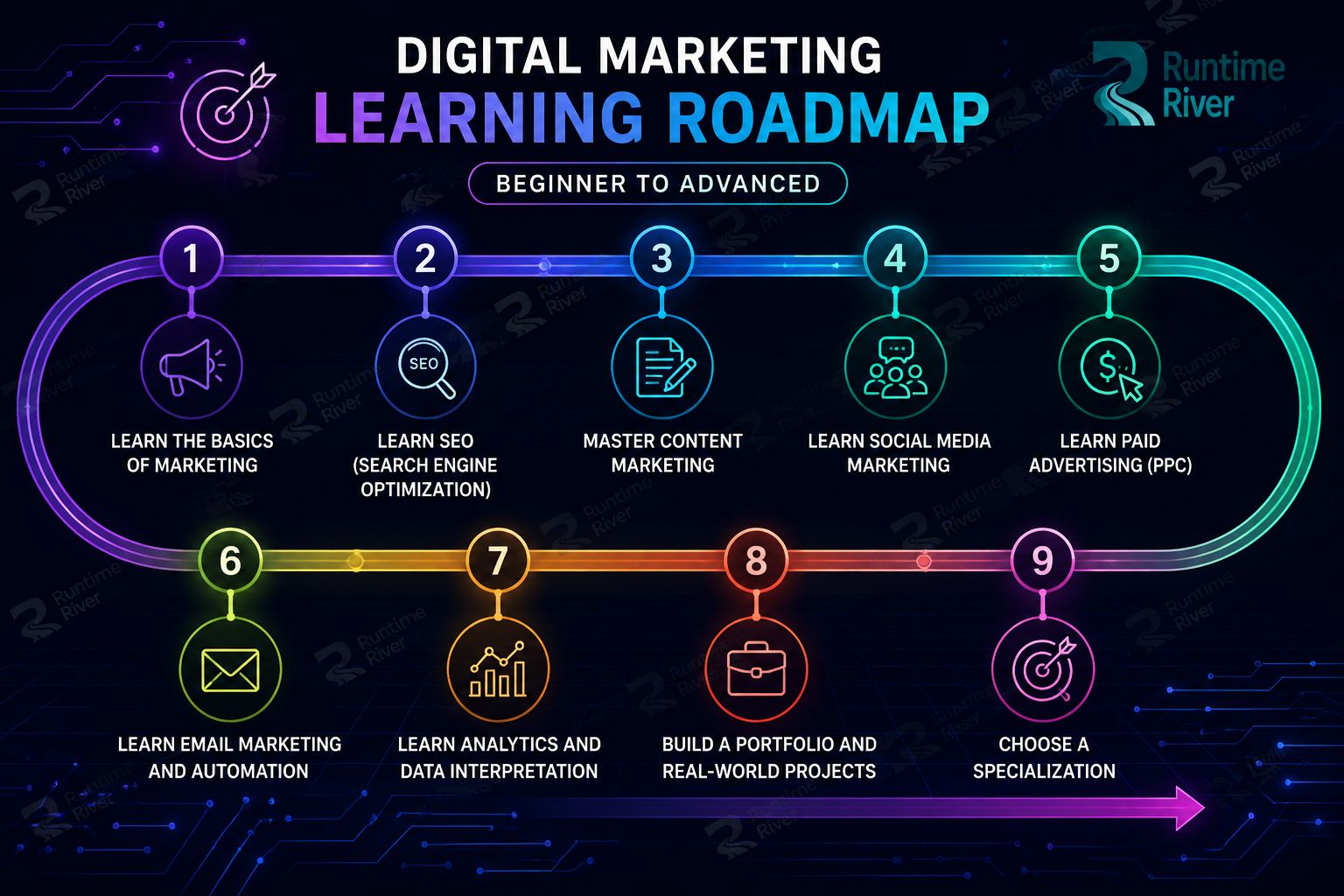
Phase 1- Learn the Basics of Marketing
Before getting into SEO and paid marketing, learn the basics about how the marketing world works. The important topics include:
Customer Journey and Sales Funnel
Buyer Persona & Target Audience
Branding and Value Propositions
Consumer Psychology
Phase 2- Learn SEO (Search Engine Optimization)
Learning SEO is the best place to begin as it involves understanding how people search online and optimize the websites to get more organic traffic. The important topics are:
Keyword Research & Search Intent
On-Page SEO
Technical SEO
Link Building
Local SEO
SEO Analytics using Google Search Console
Start your own website or blog and optimize it while learning SEO.
Phase 3- Master Content Marketing
Content marketing and SEO cannot be separated from one another. Discover how to make your content engaging and convert visitors:
Blog Writing and Copywriting
Content Strategy and Planning
Landing Pages and Lead Generation
Content Distribution
Phase 4- Learn Social Media Marketing
After you get familiar with organic search and content, move into learning about social media. Consider:
Engaging social media posts for LinkedIn, Instagram, Facebook, and YouTube
Growing social communities and followers organically
Social media performance analysis
Paid social ads
Phase 5- Learn Paid Advertising (PPC)
Pay-per-click advertising is fast and efficient in generating traffic and leads. Learn all about:
Google Ads and Meta Ads
Audience Targeting
Ad Copywriting and Campaign Structure
Conversion Tracking and Budget Management
Phase 6- Learn Email Marketing and Automation
The email channel still generates one of the best conversion rates. Important aspects:
Creating an Email Campaign
List Building and Segmentation
Setting Up Workflows for Automation
Lead Nurturing and Performance Measurement
Phase 7- Learn Analytics and Data Interpretation
Excellent marketers always base their decisions on facts, not hunches. Important tools:
Google Analytics
Google Search Console
Looker Studio
Microsoft Clarity
Phase 8- Build a Portfolio and Real-World Projects
Once you have learned enough, stop focusing on studying and start applying what you've learned to actual projects. Record each of your projects and make it a portfolio item.
Phase 9- Choose a Specialization
Find the specialization that appeals to you- SEO, Content Marketing, Social Media, PPC, Email Marketing, Analytics, or Growth Marketing.
Can You Learn Digital Marketing Without a Degree?
Yes - definitely. In digital marketing, knowledge of the subject and actual results play an essential role rather than a degree. Companies and brands are much more interested in how competent and capable the employee is.
Many famous digital marketers learned how to work and grow by watching online videos, taking various courses, learning from experts via LinkedIn articles, and doing different projects.
So, if you know how to raise the ratings of the website, find leads via Google Ads, or increase the following on social networks, then there's no need in any other qualification.
The process looks like this:
Get basic information using courses and certificates
Gain experience by working on personal projects
Create your own portfolio
Core Digital Marketing Skills to Learn
Technical Skills
SEO - Essential for ranking on Google, driving organic search traffic to your website that doesn’t require constant advertising expenditure.
Content Marketing - Blog writing, copywriting, content creation, and distribution are essential skills that underpin most digital marketing efforts.
PPC Advertising - Includes working with Google Ads and Meta Ads, along with audience targeting, campaign optimization, and conversion tracking.
Social Media Marketing - Content strategy and management, organic growth hacks, and social media advertising.
Email Marketing - Email campaign setup, automation, audience segmentation, and analysis.
Marketing Analytics - Familiarity with Google Analytics, Google Search Console, Looker Studio, and Google Tag Manager.
Soft Skills
It’s not just about technical know-how. Digital marketers who excel also have skills such as communication, creativity, critical thinking, problem-solving, and adaptability since things keep changing all the time with technology.
AI Skills Have Become Crucial
AI is revolutionizing marketing processes. The ones who know how to leverage AI in areas such as content generation, prompt creation, research, campaign optimization, and automation will have an advantage over others.
Best Free Resources to Learn Digital Marketing
Learning digital marketing skills doesn’t necessarily mean that you have to invest your money. Some of the best free learning resources are:
Google Digital Garage - Easy-to-understand courses on the basics of digital marketing and growing an online business.
HubSpot Academy - Industry-accredited certification courses in areas like Content Marketing, Email Marketing, Inbound Marketing, and Social Media. Very hands-on.
Google Skillshop - The only official place where you can get trained in Google Ads and Google Analytics 4. The certifications here are widely acknowledged.
Ahrefs Blog - One of the best places for learning SEO and content marketing with information about keywords and links.
Semrush Academy - Free courses in SEO, PPC, content marketing, and analysis with industry-expert certificates.
YouTube Channels - Neil Patel, Ahrefs, Semrush, HubSpot, and Adam Erhart provide tutorials and industry insights on a regular basis.
Industry Blogs and Newsletters - Subscribe to Ahrefs, Semrush, HubSpot, Search Engine Journal, and Moz to be updated about algorithm changes and other marketing developments.
Pro tip - Do not waste your time going through all of these resources. Stick to one course platform, SEO blog, and YouTube channel at a time.
Hands-On Projects to Build Practical Experience
While reading articles and watching tutorials is necessary, true learning occurs through application. Consider some of these ideas, which do not require you to have a job to start.
Launch Your Own Blog - Launch a niche blog and learn about keyword research, SEO, writing quality content, Google Analytics, and content promotion simultaneously.
Conduct Your Own SEO Campaign - Identify an existing website and conduct a campaign including keyword research, on-page optimization, internal linking, and technical SEO. Prepare a case study of your findings.
Design a Social Media Marketing Strategy - Plan and execute an entire social media campaign for a brand.
Launch Small Google Ads Campaign - A small budget is sufficient for learning campaign setup, targeting, bidding, ad creation, and conversion tracking.
Develop Email Marketing Funnel - You create lead magnets, develop an email list, automate processes, and monitor open and click-through rates.
Evaluate a Company's Digital Marketing Strategy - Select a business and review their SEO, content marketing, social media, and advertising efforts. The exercise enhances analytical skills.
Write a Case Study - Any project that involves setting goals, devising strategies, using specific tools, taking actions, generating results, and analyzing findings can be turned into a case study.
Best Digital Marketing Tools for Beginners
You don't need to learn every tool immediately. Start with these essentials:
SEO Tools- Google Search Console, Google Keyword Planner, Ahrefs, Semrush, Screaming Frog
Content Tools- ChatGPT, Grammarly, Canva, Notion, Google Docs
Social Media Tools- Buffer, Hootsuite, Later, Meta Business Suite
PPC Tools- Google Ads, Meta Ads Manager, LinkedIn Campaign Manager
Analytics Tools- Google Analytics 4, Looker Studio, Microsoft Clarity, Google Tag Manager
Email Marketing Tools- Mailchimp, Brevo, ConvertKit, HubSpot, ActiveCampaign
Start with these six- Google Analytics 4, Google Search Console, Google Ads, Canva, ChatGPT, and Mailchimp. These cover analytics, SEO, advertising, content creation, and email marketing.
How to Build a Digital Marketing Portfolio
Your portfolio can get you far further in your career than any type of certification. When businesses are looking to hire, what they want is proof that you can produce results rather than just taking a course.
What to include:
SEO Case Studies
Blog Posts and Writing Samples
Social Media Marketing Outcomes
Google Ads Campaigns
Email Marketing Funnel Examples
Reporting Analytics
Create great case studies by answering: What was the objective? What plan did you employ? What software tools were used? What steps did you undertake? What outcomes were produced?
Create a personal website for your portfolio along with your certifications, case studies, and contact details. Creating an effective personal website will show off your SEO abilities as well.
Use numbers, not actions. Change "manage social media channels" into "increased Instagram engagement by 35% within three months." Metrics make you more credible.
From three to five fully documented case studies with clear outcomes will always outweigh several half-finished initiatives.
How to Get Your First Digital Marketing Job
1. Build a LinkedIn Profile
Add a professional headline, relevant certificates, links to your portfolio, skills endorsements, and an overview of yourself. Recruiters are looking for candidates for digital marketing jobs through LinkedIn.
2. Create a Portfolio Before Applying
Be prepared to have at least a couple of projects - for example, a case study in SEO, a few blog articles, a social media initiative, or a Google Ads project.
3. Apply for Internships
Internship is one of the fastest methods to acquire industrial experience and network within the industry.
4. Begin with Freelancing
Provide services such as SEO audits, content writing, social media management, and email marketing to small businesses on platforms such as Upwork.
5. Networking
Network with professionals on LinkedIn, be a part of groups and communities of marketers, attend webinars, or participate in discussion forums. Most jobs come from referrals and not from job portals.
6. Apply for Entry-level Jobs
Job titles you can apply for include-Digital Marketing Intern, SEO Executive, Content Marketing Executive, Social Media Executive, PPC Associate, and Junior Digital Marketing Specialist.
7. Prepare for Interviews
Remember that most interviews at the beginner level tend to ask basic questions. They will want to know about- What is SEO? What is Google Ads? Which measurements would you make for your campaigns? Which tools have you worked with?
Common Mistakes to Avoid
Trying to know everything right away – Take one skill at a time, and advance slowly.
Learning content but not putting it to practice – Classes provide knowledge but doing a project is how you gain the skills.
Getting multiple certificates – Your experience counts for more than your list of certificates.
Ignoring data analysis – If you don’t analyze the data, you won’t know how successful your campaign was. Start learning Google Analytics early.
Believing that you will get instant results – SEO and content marketing are both long-term processes.
Lack of Portfolio - Your portfolio can be what lands you that job. Begin building projects right away, yes, even if it’s personal
Digital Marketing Career Paths and Salary Insights
Different options exist for digital marketers based on their skills and interests:
SEO specialist – Works on improving organic search performance by utilizing keyword research, on-page SEO, link building, and technical SEO.
Content Marketing specialist – Develops valuable content to attract and engage people; best for those with strong writing skills.
Social media manager – Responsible for developing social media campaigns and analyzing their results.
PPC specialist – Responsible for managing all advertising campaigns on Google, Meta, and LinkedIn; performance-oriented.
Email marketing specialist – Specializes in creating email marketing campaigns and automation.
Marketing Analyst - Analyzes data obtained using Google Analytics, CRMs, and BI applications to assess performance and influence decisions
Digital Marketing Manager - High-level position managing various channels, budgeting, coordinating teams, and strategizing
Freelance Digital Marketer - Independent consultant for various customers providing specific services
Which specializations earn the most? Specializations like Performance Marketing (PPC), SEO Consulting, Growth Marketing, Marketing Analytics, and CRO generate higher remuneration since they directly affect business performance.
The salary potential increases drastically depending on the level of experience. Beginners build a basis, mid-level professionals (2-5 years of experience) get high bonuses, while seniors and high-level positions guarantee the best salary. Freelancers with unique skills can earn more than regular employees working with multiple clients.
The Future of Digital Marketing
The field continues to evolve rapidly. Here's what's shaping its future:
AI Marketing - With the help of AI, marketing automation, keyword research, advertising, customer support, and reporting can be carried out more efficiently. Effective utilization of AI will give companies an edge over those who do not.
Scale Personalization - Today, consumers want more personalized experiences. Personalized emails, ads, and website content based on data will be common.
Video Strategy - Short form and long form videos on YouTube, Instagram Reels, TikTok, and LinkedIn continue to get popular. Having video strategy is no longer optional.
Marketing Automation - Email workflows, customer nurturing, and reportings will become key marketing components.
Data and Analytics - With growing competition, companies are increasingly depending on data for decision-making purposes. Those marketers who can convert data into actionable insights will remain highly sought after.
Those marketers who will remain flexible and adapt with the times, combining their solid foundation with current technology, will have a bright future ahead of them. Algorithms and technology might change but understanding your audience, adding value, and showing positive results will always remain relevant.
Conclusion
Mastering digital marketing skills is significantly simplified through the development of an organized roadmap while paying attention to one skill at a time. Whether it is marketing basics, SEO, or social media, PPC, email marketing, or analytics, each of these skills adds tremendous value to your portfolio.
Certifications alone are not everything. Rather, it is important to put your knowledge into practice through projects, learning from your results, and honing your skills in such a way that you get practical experience valued by clients and employers.
If you are planning a full-time career in marketing, wish to become a freelancer or help your business grow, or simply want to create a brand for yourself – now is definitely the right time to do it!