Artificial Intelligence has quickly transformed from an idea of the future into the fundamental technology used within business. Enterprises have started creating chatbots, virtual assistants, text creators, code helpers, and smart search tools for greater efficiency and improved consumer interactions using AI. The development of such applications, nevertheless, involved handling complicated machine learning setup, large language models, and costly computer resources.
AWS addressed this by developing AWS Bedrock, a fully-managed generative AI platform that allows organizations to create advanced AI solutions using top foundation models using only one API.
☰Table of Contents |
In this blog, we will take a closer look at AWS Bedrock, see how it works, its main capabilities, architecture, use cases, costs, and why it is one of the most crucial services within AWS ecosystem.
What is AWS Bedrock?
AWS Bedrock is a fully managed generative artificial intelligence platform that offers easy access to many foundational models (FMs) from top AI companies using a single API. It enables developers to create AI apps without worrying about infrastructure management, GPU configuration, and manual deployment of machine learning models.
In other words, AWS Bedrock serves as an intermediary between your app and state-of-the-art AI models, which means that you can use various AI models without actually hosting them yourself. Moreover, you get advanced enterprise-level security and control for each model.
With Amazon Bedrock, organizations can:
Build AI chatbots and virtual assistants
Create content generation tools
Develop document analysis applications
Implement Retrieval-Augmented Generation (RAG)
Build AI agents that perform tasks autonomously
Integrate generative AI into existing business workflows
The most significant benefit is flexibility, meaning that companies do not have to work with just one AI model but can pick several models from different providers according to their needs.
Key Takeaways
Before exploring further, let us go through the key things you should know about AWS Bedrock:
AWS Bedrock is a managed generative AI service.
You get access to several foundation models via a single API.
There is no need for GPU provisioning or hosting any models.
It offers RAG support.
It helps you create AI agents and automate workflows.
It offers enterprise security and governance.
Businesses can swap out models with minimal application modifications.
Why AWS Introduced Bedrock?
There were numerous opportunities brought about by the emergence of generative AI; however, these opportunities came at a price and posed a series of technical difficulties.
Organizations looking to develop AI applications were required to:
Acquire costly GPU compute resources
Deploy and maintain big language models
Monitor the performance of the models
Scale their infrastructure
Create security and compliance measures
Update the model
For most companies, particularly those lacking an AI department, this process proved cumbersome and expensive.
AWS realized that customers were looking to capitalize on the potential offered by the generative AI technology without the burden of managing their own infrastructure.
Bedrock addresses this need by offering developers a platform where they can concentrate on developing applications, and AWS takes care of everything else.
How AWS Bedrock Works
Broadly speaking, AWS Bedrock acts as an orchestration layer between the applications and foundation models.
In case of any interaction by the user with an AI-enabled application, the request goes to Bedrock. Then, Bedrock sends the request to the selected foundation model, receives the response, and passes it back to the application.
The following stages take place:
Stage 1: User Interaction
The user submits a prompt via the chatbot, website, application, or enterprise system.
Stage 2: Request Handling
The request is passed on to AWS Bedrock through API or SDK calls by the application.
Stage 3: Model Selection
Bedrock redirects the request to the selected foundation model.
Stage 4: Data Collection (optional)
In case of enabling Knowledge Bases, relevant data is fetched from connected enterprise data sources.
Step 5: Generate Responses
The model creates a response by combining the prompt and the retrieved data.
Step 6: Delivery of the Output
The generated response is then delivered to the application interface for the user to see. This approach allows companies to design complex AI applications without worrying about maintaining the model’s underlying technology.
AWS Bedrock Architecture
Knowledge about the architectural components of AWS Bedrock is important when building scalable AI applications.
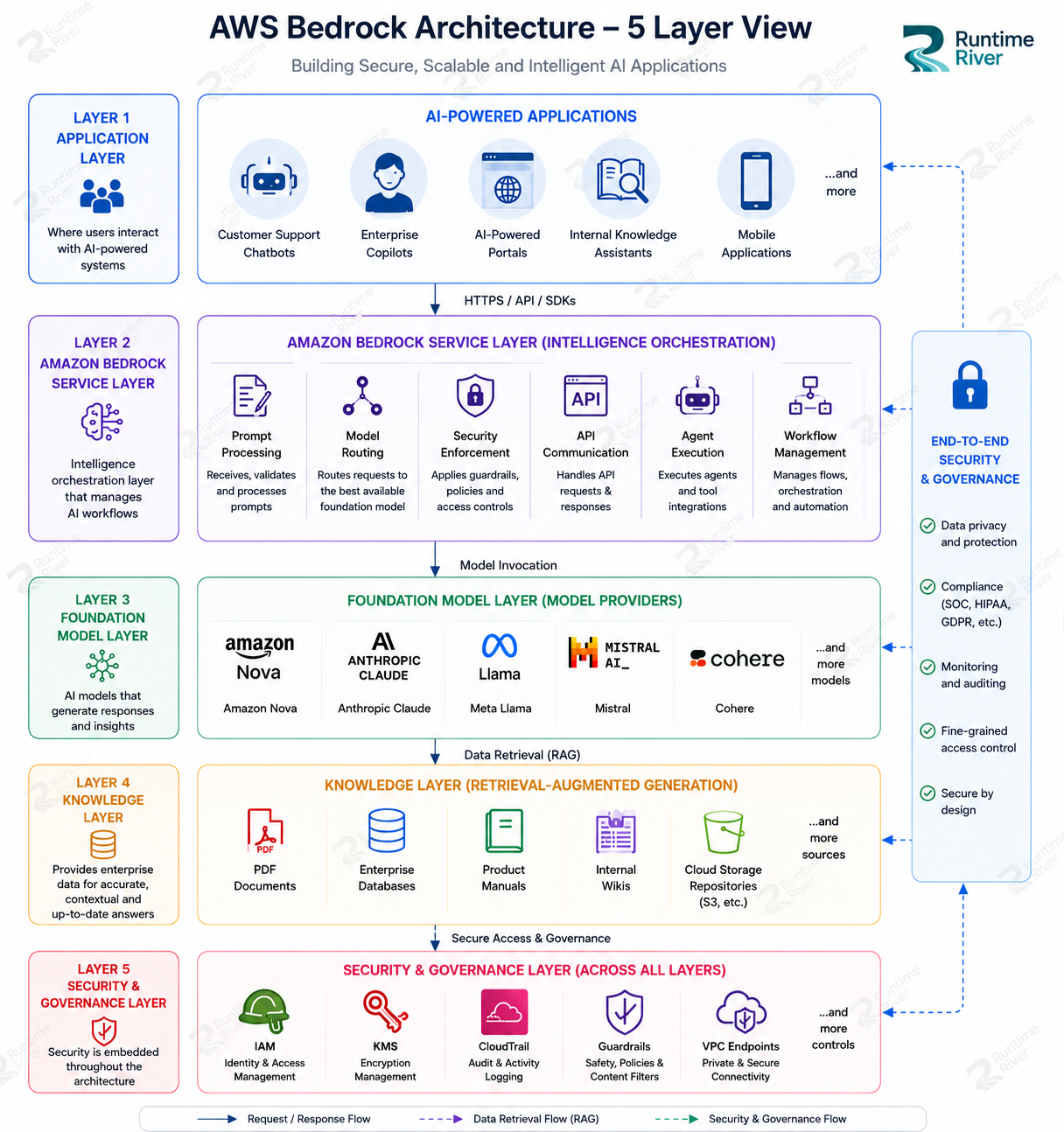
AWS Bedrock also uses a layered architecture where each layer includes interactions of the end users, orchestration of AI, computation of the models, retrieval of enterprise knowledge, and security mechanisms. Using this approach, organizations can easily build scalable AI applications without having to manage any underlying infrastructure or models.
The architecture of AWS Bedrock includes five main layers.
Layer 1: Application Layer
This layer constitutes the point where the user interacts with the AI solution. It involves all front-end applications that use Bedrock services for their AI functionalities.
Examples of this layer include:
Chatbots for Customer Support
AI Copilots for Businesses
Knowledge Management for Enterprises
Portals using AI Capabilities
Mobile Applications
The main function of this layer is to receive input from the user and send communications to Amazon Bedrock services via APIs and SDKs.
Layer 2: Amazon Bedrock Service Layer
The Amazon Bedrock Service Layer serves as the orchestration hub of the architecture. It works at an intermediary level between applications and the foundation models.
It is responsible for:
Prompt Processing
Model Routing
Enforcement of Security
API Communication
Agent Execution
Workflow Management
For instance, when a user provides a prompt, Bedrock decides on the model to use, enforces security requirements, acquires further context when necessary, and manages the entire prompting process.
This way, developers get to work on applications without having to worry about the underlying AI.
Layer 3: Foundation Model Layer
Foundation Model Layer consists of the AI models that understand prompts and produce responses.
Among the models available via AWS Bedrock are:
Amazon Nova
Anthropic Claude
Meta Llama
Mistral AI
Cohere
Some of the use cases enabled by foundation models include content generation, question answering, summarization, code generation, translation, and reasoning tasks.
Flexibility of model usage is one of the key strengths of Bedrock services.
Layer 4: Knowledge Layer
Knowledge layer is used to implement RAG, which means that Bedrock retrieves enterprise information before generating its response.
In contrast to pre-trained model information alone, the Bedrock system will be able to retrieve information from:
PDF files
Enterprise databases
Product manuals
Internal wikis
Amazon S3 storage repository
This way, the system will be able to gather relevant information for the user’s request before it is sent to the machine learning model.
Layer 5: Security & Governance Layer
Both Security & Governance permeate each layer of the AWS Bedrock framework. Instead of forming a separate layer themselves, they cut across the whole architecture.
Some of the services that come under this are:
Identity and Access Management (IAM)
AWS Key Management Service (KMS) for encryption
CloudTrail for auditing and monitoring
Guardrails for safe AI content generation and filtering
VPC endpoints for private connectivity
These services assist in ensuring sensitive data is safe, maintaining compliance, monitoring and enforcing AI use policies.
End-To-End Request Processing
A common request follows the following path:
A user engages in conversation with a software application that uses AI.
The application forwards the request to AWS Bedrock.
Bedrock processes the request and enforces security protocols.
Enterprise information is fetched using the knowledge layer.
The chosen foundation model produces a reply.
Guardrails validate the reply.
The reply is forwarded back to the application.
Using such an architecture, AWS Bedrock can use all four aspects of foundation models, enterprise data, workflow automation, and security controls to form a single integrated platform for generative AI applications.
Core Components of AWS Bedrock
There are multiple components offered by AWS Bedrock that help enterprises create, customize, and launch generative AI applications as follows:
Foundation Models (FMs): This component is based on pre-trained AI models from vendors like Amazon Nova, Anthropic Claude, Meta Llama, Cohere, and Mistral.
Knowledge Bases: It involves connecting to enterprise data sources and allowing for Retrieval-Augmented Generation (RAG).
Agents: Tasks can be automated through the use of APIs, databases, and business systems.
Guardrails: Content moderation, privacy, and AI safety measures can be established.
Prompt Management: Allows creating, saving, versioning, and reusing prompts in different applications.
Model Customization: It allows fine-tuning and customizing the foundation models using company-specific data.
Flows: Multi-step AI workflows can be designed and orchestrated visually.
Evaluation Metrics: Performance, accuracy, and quality of responses can be evaluated.
Security & Governance: Integration with services such as IAM, KMS, CloudTrail, and VPC.
AWS Bedrock Use Cases
The versatility of AWS Bedrock is one of the reasons why it stands out as a platform. Through the integration of foundation models, Knowledge Bases, Agents, and workflow automation, the platform allows businesses to create diverse artificial intelligence solutions. Below are some examples of use cases:
1. AI Customer Support
Bedrock can be used to create intelligent bots and assistants that help answer customers' questions at any time of day.
Capabilities of these AI tools may include:
Responding to frequently asked questions
Tracking orders
Providing details about products or services
Addressing any issues related to accounts
Forwarding more complicated questions to human support staff
Through the incorporation of knowledge bases, these AI assistants can give correct answers based on company documentation.
2. Enterprise Search & Knowledge Management
With the help of Bedrock, employees can fetch data from internal systems through natural-language queries, without needing to search for it manually within documents and databases.
Some examples are:
Company policies
Guidelines for compliance
Internal documentation
Business reports
Product knowledge bases
3. AI Copilots for Employees
AI copilots are now increasingly being used by organizations to help their employees perform everyday tasks more efficiently.
These copilots can:
Write emails
Create meeting summaries
Make reports
Perform research
Answer internal questions
4. Intelligent Document Processing & Analysis
Bedrock is capable of processing huge amounts of documents in mere seconds and fetching meaningful insights out of them.
Common use-cases are:
Contract analysis
Invoice analysis
Report summarization
Compliance reviews
Legal document analysis
For instance, a legal team can request Bedrock to make a summary of an extensive contract and highlight important clauses.
5. AI Agents and Workflow Automation
Bedrock Agents allow you to automate your business processes by going beyond basic conversations.
AI agents are capable of:
Connecting to databases
Calling APIs
Modifying records
Initiating workflows
Performing complex procedures
As a result, Bedrock is suitable for HR departments, customer service, IT processes, and business process automation.
6. Software Development Support
Development teams can leverage coding assistants based on Bedrock to enhance their efficiency during the entire software development process.
Some typical applications are:
Code generation
Debugging assistance
Creation of documentation
Generation of test cases
Code explanation
AWS Bedrock offers all the necessary tools to develop scalable generative AI solutions for all industries, from automated customer support to enterprise search and intelligent analytics.
AWS Bedrock vs Amazon SageMaker
Even though AWS Bedrock and Amazon SageMaker belong to AI-related services of AWS, they serve completely different purposes.
It is crucial to understand which one will suit your business needs best.
Feature | AWS Bedrock | Amazon SageMaker |
|---|---|---|
Primary Purpose | Build and deploy Generative AI applications | Build, train, and deploy Machine Learning models |
Target Users | Developers, AI Engineers, Solution Architects | Data Scientists, ML Engineers |
Infrastructure Management | Fully managed by AWS | Requires more infrastructure and ML pipeline management |
Foundation Models Access | Built-in access to multiple foundation models | Models must be deployed or integrated separately |
Supported Model Providers | Amazon Nova, Claude, Llama, Mistral, Cohere, and more | Custom and open-source models |
Generative AI Focus | Purpose-built for Generative AI | General-purpose ML platform |
Model Training | Limited customization and fine-tuning | Full model training and experimentation capabilities |
Knowledge Bases (RAG) | Native support | Requires custom implementation |
AI Agents | Native Bedrock Agents support | Requires custom development |
Prompt Management | Built-in | Requires custom setup |
Workflow Orchestration | Bedrock Flows | SageMaker Pipelines |
Security & Governance | Built-in Guardrails and governance controls | AWS security services integration |
Deployment Speed | Faster deployment for AI applications | Longer setup and development cycle |
Scalability | Automatic scaling managed by AWS | Highly scalable but requires configuration |
Customization Level | Moderate | Extensive |
Best For | Chatbots, AI Assistants, RAG Applications, AI Agents | Custom ML Models, Predictive Analytics, Advanced ML Workloads |
Learning Curve | Beginner to Intermediate | Intermediate to Advanced |
When to Select AWS Bedrock
The following reasons will justify the selection of AWS Bedrock:
Fast AI application creation.
Multiple foundation models are available.
Managed infrastructure is desired.
Creation of chatbots, copilots, or other types of AI agents.
Enterprise-level governance is required.
When to Select Amazon SageMaker
Amazon SageMaker will be more useful when:
You require full control over model training.
Custom machine learning models must be built.
Advanced experimentation is necessary.
Professional ML engineers work on the project.
Usually, both services are integrated into the same business.
In many organizations, Bedrock and SageMaker are used together rather than as competing services.
Benefits of AWS Bedrock
Speeds Up Development of Generative AI because developers can create applications that use AI without worrying about infrastructure.
Fully Managed AWS service that is responsible for taking care of models' hosting, scaling, maintenance, and availability.
Provides Multiple Foundation Models such as Amazon Nova, Claude, Llama, Cohere, and Mistral using one API.
Allows Developing AI Apps for Enterprises such as chatbots, virtual assistants, AI co-pilots, and AI search engines.
Includes Built-In Knowledge Bases and RAG functionality that connects AI models to an organization’s knowledge bases.
AI Agents for Workflow Automation that can work with APIs, databases, and other business systems.
Enterprise-level security and compliance features based on IAM, KMS, CloudTrail, Guardrails, and VPC capabilities.
Decreased costs of hosting and using GPU clusters by not having to manage infrastructure.
Limitations of AWS Bedrock
Pricing based on Usage may lead to higher expenses when handling Generative AI at scale.
Less Control over Models than in the case of self-hosting or using open-source foundation models.
Training Advanced Models necessitates Amazon SageMaker for machine learning customization.
Regional Restrictions can pose challenges in accessing particular models and functionalities.
Vendor Lock-In may become an issue due to reliance on the AWS ecosystem.
Performance Differences between Models depending on use cases.
Less Flexibility in Customizing Models than with proprietary AI models.
Cost Optimization Measures must be applied in order to reduce inference expenses.
Governance Strategy Development remains important for implementing AI solutions.
Access to Third-Party Models is possible through AWS partnerships with providers.
Is AWS Bedrock Worth Learning in 2026?
There is an ever-increasing demand for the skills in generative AI. With the transition from AI pilots to real production environments, experts with knowledge of AWS Bedrock will become even more important.
Here are some reasons why it is worth learning Bedrock:
Cloud Engineer
Solution Architect
AI Engineer
Machine Learning Engineer
DevOps Engineer
Platform Engineer
Software Developer
The core competencies in relation to AWS Bedrock include:
Prompt Engineering
RAG Architecture
AI Agents
AI Knowledge Bases
AI Governance
Cloud Native AI Development
With AWS being a leading cloud provider, AWS Bedrock will be in high demand for business solutions over the coming years.
Conclusion
Amazon Bedrock is rapidly becoming one of the most critical services in the AWS AI ecosystem. With its offering of managed access to state-of-the-art foundation models, enterprise-level security features, knowledge retrieval functionalities, and AI agent capabilities, Bedrock makes the development of contemporary AI applications much easier.
Whatever you may be working on – be it a customer support chatbot, retrieval-augmented generation model, enterprise copilot, or autonomous AI agents – AWS Bedrock offers the necessary capabilities to transition your ideas into real-world solutions.
With generative AI increasingly transforming industries, learning about AWS Bedrock is not just advantageous but practically mandatory.